Key facts: Water Extraction in Peachtree Corners
What differs
Finished lower levels hold the deepest water
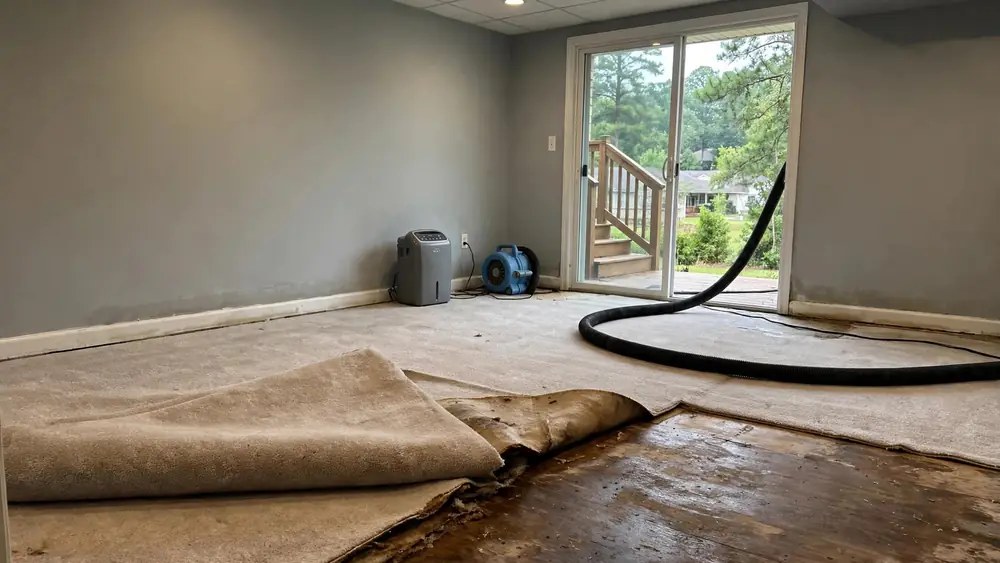
Sloped lots in this city often mean a house with a walk-out on one side and a buried wall on the other, so water tends to collect along the side with no door. Carpet over pad on concrete is a very common finish, and pad on a slab has nowhere to drain. An extractor can pull most of the water from the carpet, but the pad and tack strip by the buried wall often have to come out, and the wall itself should be read for moisture behind the baseboard.
The source is often in the same room: a water heater or furnace closet, a wet bar line or a lower-level bathroom. Those sources are simple to shut off if you know where the valve is. If your water heater has failed, close its cold-water supply and turn off its gas or breaker following the maker's directions, and only then begin moving belongings around.
Common sources
What tends to flood a lower level here
| Source | Clue | First step |
|---|---|---|
| Water heater failure | Water around the closet, tank bottom rusted | Close supply, turn off energy source |
| Sump pump failure | Water around the pit during rain | Check power and float; lift belongings |
| Lower-level bath drain | Water comes up at the tub or toilet | Stop using water; call county dispatch if widespread |
| Uphill wall seepage | Damp along one wall after a storm | Move things away; check gutters later |
| Washer hose | Sudden flow near a laundry closet | Close the valves behind the machine |
On the day
Extraction on a typical finished level
- 1
Power check
Lower-level circuits are switched off if water is close to outlets. A contractor may run cords from a dry floor.
- 2
Contents out
Sofas, shelves and boxes move to the garage or upstairs. Anything wet that bleeds color gets separated.
- 3
Carpet pulled back
Once extracted, the carpet may be folded back so that the pad can come out and air can reach the slab.
- 4
Baseboards and readings
Wet baseboards come off, and readings along the wall show whether flood cuts will be needed.
- 5
Discharge managed
Water goes down a suitable drain or away from the house, and not toward the wall it came through.
Outdoors
Hoses, slopes and neighbours
Wooded lots look lovely but make for awkward hose runs. A truck may have to stop at the top of a steep drive, with the hose running down the side of the house to the walk-out. Roots and landscaping can snag it, and on a wet day the ground may be slick, so ask that clear paths be kept and hoses protected at doors. Pumped water should be sent downhill and away from the foundation, without causing erosion or running across into a neighbour's lot.
An HOA may have views on trucks, dumpsters and hours of work, and it is easier to mention these at the start. This does not stop urgent water removal, but a courteous word can prevent complaints later. If a city permit becomes necessary for the rebuild, it comes from the Peachtree Corners Building Division rather than the county. [2]
Near the river
If the water came from outside
Homes close to the Chattahoochee or its creeks face a different problem if the water rose from outside. [1] Outside floodwater is treated as contaminated, so extraction is carried out with protective equipment and most porous finishes on that level come out. The EPA has guidance on keeping indoor air safe after such an event. [3] Insurance also differs, since homeowners policies generally exclude flooding. Take photographs of the water line before it is cleaned off, and speak to your agent the same day.
Offices
Technology Park and commercial floors
Commercial carpet tile, raised floors and server rooms in Tech Park need their own approach. Carpet tile can often be lifted and stacked quickly, exposing a wet slab to extract, and raised floors may need panels lifted to reach the water below. Building management normally leads, and it is best to shut down and unplug wet equipment before anyone begins work. If your suite is affected, photograph equipment and serial numbers before moving anything.
Belongings
Storage rooms and home offices on the lower level
Lower levels here often double as a storage room, a home office or a playroom, and that is what makes extraction slow. Cardboard boxes on carpet soak from the bottom and collapse when lifted, so use a flat board or a plastic tub to move them, and open them the same day. Paper files, photographs and holiday items are usually at the bottom of the pile. Computers should be unplugged and left off until checked, even if they seem dry, and it is worth asking separately about any data they hold. Treadmills, pool tables and other heavy pieces are hard to shift, so ask the crew how they plan to deal with carpet beneath them. Sometimes the answer is lifting with blocks and working around the item, and sometimes the piece has to be dismantled. Clear a space in the garage ahead of time if you can, and lay something down to protect its floor. A short list of what went where will save time when the room is rebuilt.
Remember that wet boxes get heavy, so ask for help rather than risk an injury on the stairs.
Two people and a flat board make the job far safer.
Questions
Peachtree Corners extraction questions
Should I run the sump pump if the lower level is flooded?
If the pump is working, the power is safe and the water is clean, yes. Do not reach into a pit in standing water if you have any doubts about the electrics. A pump that is overwhelmed in a storm can be supplemented by a contractor once conditions are safe.
Can lower-level carpet on concrete be saved?
Sometimes, if the water was clean and the response was fast. The pad on concrete almost always goes, and the carpet can be dried and re-stretched if it has not delaminated. Sewage or floodwater generally means carpet and pad are both removed.
Who shuts off water at the street if my valve fails?
Gwinnett County handles the public side, and its dispatch line takes reports of problems at the meter box or in the street: 678.376.7000. For a failed valve inside your home, you will need a plumber. [4] [5]
Do I need to tell my HOA about extraction?
Not usually for work inside a detached home, although some associations have rules about dumpsters and trucks. In townhomes it matters more, since neighbours and shared walls may be affected. Check your covenants, and let a board member know early if shared elements may be involved.