Key facts: Burst Pipes in Historic Norcross
What differs
Plumbing that came after the house
Norcross was chartered in 1870, and many early houses predate indoor plumbing as we know it, so water lines arrived later and were threaded through whatever route was convenient. [1] That can mean supply pipes along an outer wall, under a raised floor exposed to wind, or through a closet added under the eaves. Different eras of pipe may be joined together too, and old galvanized sections can sit next to newer copper or plastic. Each join is a possible weak point, and a freeze tends to find it.
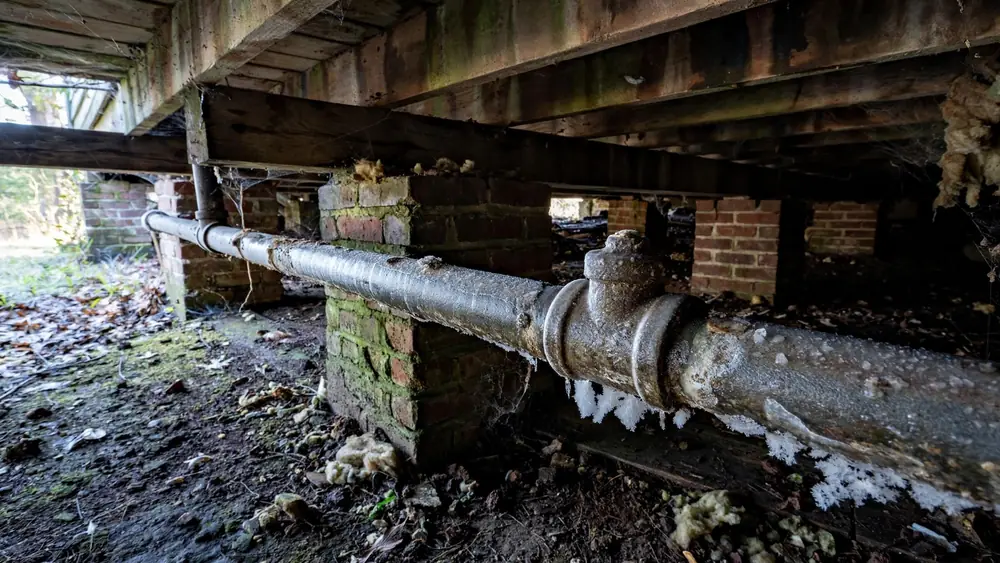
Pier and open foundations are the biggest exposure. Cold air moves freely under the floor on a windy night, and a lightly insulated pipe there has little protection. During the long December 2022 cold, the airport reportedly spent close to 56 hours below freezing, the kind of stretch these runs were never built to endure. [2]
First minutes
What to do in an old house
- 1
Try the valve gently
Old gate valves can break if forced. If it will not move, go to the meter box or call a plumber; ask county dispatch for help with anything at the meter. [4]
- 2
Open a low faucet
Draining the line reduces the flow from the split.
- 3
Keep clear of plaster ceilings
They are heavy and can drop in big pieces when wet.
- 4
Shut off wet circuits only from a safe place
Old wiring may run through the wet area, so do not touch any fixture.
- 5
Lift rugs and rescue original pieces
Pick up any fallen trim or hardware and keep it, labelled.
- 6
Photograph before repairs
Capture the failed section and the original finishes affected.
Repair choices
Fixing a line in an old building
| Situation | Common approach | Point to weigh |
|---|---|---|
| Single split in exposed crawl line | Repair and insulate | Check nearby joints when pressure returns |
| Old galvanized pipe, low flow | Plan to replace the run | Fittings may be fragile |
| Line in a plaster wall | Reroute if a hidden path exists | Avoid cutting decorative plaster |
| Pipe with old insulating wrap | Test wrap before disturbing it | Older wraps may contain asbestos |
| Outside hose bib on old wall | Fit a suitable valve or frost-resistant bib | Exterior work may meet design review |
Walls
Keeping original finishes
Getting to a burst pipe often means opening a wall. In an old house, ask whether the line can be reached from a closet, from the crawl space or through a less decorative surface. Plaster cuts are hard to hide and may bring down more than intended, so a careful plumber will score the surface and support the area. Painted surfaces in houses of this age may contain lead, which is why EPA lead-safe practices can apply to paid work. [3] Keep any cut trim, because new pieces may not match the old profile.
Once the plumbing is repaired, drying follows at a modest pace. Old floors and plaster often come back if treated gently, and our structural drying page for this area goes into detail. Exterior changes such as a new vent or hose bib should be checked with the city before work is done. [5]
Before winter
Protecting an old house from the next freeze
- Walk the crawl spaceNote where lines run, and insulate those you can reach. Choose materials that tolerate damp.
- Reduce wind under the floorTemporary covers on foundation openings can help in a hard freeze, if they do not damage anything. Remove them afterward so that the space can dry.
- Find every shutoffOld houses may have more than one. Label them and test them gently before you need them.
- Open cabinets on outer wallsLet room heat reach under kitchen and bath sinks on the coldest nights.
- Drip the farthest faucetA small trickle on the line most at risk relieves pressure during a hard freeze. [6]
Commercial
Storefronts on the old streets
Commercial buildings beside the park may have upper floors with old lines, and a split above a shop can reach it through a tin or plaster ceiling. Tell your landlord right away and find out who has access to the shutoff if the building is locked overnight. If you lease, keep a note of the valve location and the landlord's number somewhere you can get at it in the dark.
Insurance
Old houses and pipe claims
Insurers may ask about the age and condition of plumbing in an older house, and they may distinguish between sudden failure and long-term corrosion. Keep the plumber's written description of what failed and why, plus the failed section of pipe. If only like-kind plaster or old-growth floors can properly restore a room, say so early and send photographs of what was there before. Policies vary in how they handle older finishes, and some limit replacement to modern equivalents unless certain coverage is in place. Ordinance or law coverage might also matter if bringing a run up to current code is required once a wall is open. Ask your agent to explain this while the repair is still being planned, rather than after the plaster has been replaced. The Georgia Office of Commissioner of Insurance offers help to consumers who have questions about their insurer. [7] A simple file with dates, photographs and names will make any of those conversations far easier for you.
Keep any old pipe you replace until the claim closes, labelled with the date and location. Adjusters and plumbers may both want to see it.
Questions
Old-house burst pipe questions
Why do my old pipes freeze when the neighbours' do not?
Probably because of where they run. A line under a raised floor or inside an outer wall is far more exposed than one in a heated interior wall. Insulation, reduced wind under the house and a drip on the coldest nights all help.
Can a plumber fix a pipe without damaging plaster?
Often they can reduce the damage by working from a closet, the crawl space or the floor above. Sometimes a wall has to be opened. Ask to see the plan first, and have a plaster repair person lined up for anything decorative.
Should I replace all the old pipe after one burst?
Not automatically. One clean split in sound pipe may just need a repair and insulation. Repeated leaks, rust and low flow suggest the run is at the end of its life. A plumber can inspect and let you plan the replacement to protect finishes.
Is old pipe insulation dangerous?
It may be. Some older pipe wraps contain asbestos, and disturbing them can release fibres. Do not cut or remove any wrap of unknown age. Have it tested, and let trained people handle it if the result is positive.
Sources and citations
- [1]Wikipedia: Norcross, Georgia
- [2]11Alive: Atlanta could spend 40 hours below freezing
- [3]U.S. EPA: Lead Renovation, Repair and Painting Program
- [4]Gwinnett County Water Resources: Report a problem
- [5]City of Norcross: Certificate of Appropriateness application
- [6]Ready.gov: Winter weather
- [7]Georgia Office of Commissioner of Insurance