Key facts: Crawl Space Water Damage in Historic Norcross
What differs
Open foundations and bare soil
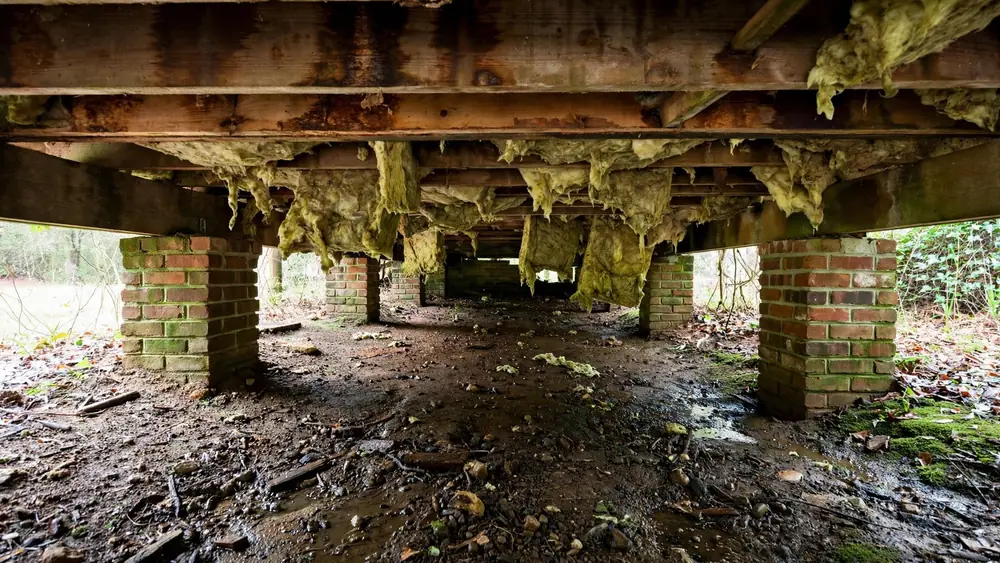
Basements are less the issue downtown than the space beneath raised floors. A crawl space is the narrow gap between ground and first floor, and it often carries ductwork and plumbing. [1] In older houses it may have dirt floors and low clearance, with brick piers or a perimeter wall that was never meant to be airtight. After heavy rain, water can sheet across that soil, and even when it drains away, the ground keeps giving off moisture for days.
Most of the signs show up in the rooms above: a musty smell, floors that swell seasonally, doors that stick after a wet week. Below the floor, look for dark staining on joists, sagging or fallen insulation, and white salts on the brick. Those are clues to a long-term moisture problem rather than to a single event, and they need a different answer from a simple cleanup.
What you find
Reading an old crawl space
| What you see | May suggest | Next step |
|---|---|---|
| Soil dark and wet after rain | Runoff passing under the house | Check gutters and surface flow |
| Wet patch under a bath | Drain or supply leak | Bring in a plumber |
| Smell of sewage | Broken drain line | Stay out, call a plumber |
| Soft wood at the sill or a pier | Possible rot or insect damage | Have structure assessed |
| Salt on brick | Moisture moving through masonry | Find the source; do not just scrub |
The work
Restoring a wet crawl under an old floor
- 1
Check for hazards
Old wiring, pipe wrap, droppings and any contamination come first. Older wrap should be tested before it is touched.
- 2
Pump low spots
Remove ponded water and grade any hollows that keep collecting it.
- 3
Remove wet insulation
Soaked batts come down so that joists and boards can dry.
- 4
Cover the ground
A continuous vapor barrier stops soil moisture rising toward the floor.
- 5
Dry the framing
Dehumidifiers work best if openings are managed. Readings on joists show progress.
- 6
Follow through upstairs
Allow old floors to settle before you make any decision about refinishing.
Openings
Vents, lattice and design review
Foundation openings, brick screens and porch lattice can be a visible part of an old house. Closing them to condition the crawl space changes both how the building looks and how it breathes. A sealed crawl space can work well, but it should be designed as a system, with any combustion appliances and HVAC taken into account. Removable covers for hard freezes are a smaller step. Check with Norcross Community Development before altering anything that shows from outside, because the Certificate of Appropriateness process exists for exactly that kind of change. [3]
Interior measures are usually simpler to approve, including vapor barriers, dehumidifiers, and repairs to wiring and plumbing below the floor. Keep in mind that trades work may still need a permit, even when nothing visible changes.
Rain and runoff
Stopping water before it arrives
Start outdoors. Old houses often have gutters that discharge beside the piers, flower beds built up against the foundation and old walks that tilt toward the house. Rain totals here are substantial; the National Weather Service recorded 53.81 inches at Atlanta in 2021. [2] A modelled Open-Meteo estimate for Norcross is around 62 inches a year long term, which should be read as an estimate only. Extend downspouts, restore a slope away from the walls and clear any drains that have silted up over the years. Each one is simple, and each removes some water that would otherwise pass under your floor.
If the lot sits low relative to its neighbours or the street, a shallow surface drain may help. Check with the city about where it can discharge, and do not send water onto a neighbouring lot. Public storm drain problems go to Gwinnett's dispatch line. [4]
Structure
When the wood has been wet for years
Old heart pine can be remarkably durable, but sills and joist ends in long-term contact with damp masonry can decay. Probe suspect areas gently with an awl and have anything soft looked at by a carpenter or structural professional experienced with old buildings. Repairing a sill or sistering a joist is ordinary work on a house this age, and it is far better done on your own schedule than after a floor begins to sag.
Who to hire
Choosing help for an old foundation
Some crawl space companies sell a standard package of liner, sealing and dehumidifier, and it may or may not suit a house on old brick piers. Before you agree, ask how the proposal treats the existing openings, combustion appliances and the look of the foundation. Ask if the contractor has worked on houses of this age, and ask to see a written scope that explains why each item is needed. A second opinion is reasonable for any major work. If masonry is deteriorating, a mason familiar with old brick should advise, because hard modern mortar can damage soft historic brick as it weathers. Structural issues need a suitable professional rather than a salesperson. Take care with pressure to sign quickly because of mold fears. Dark staining on old joists does not by itself mean that immediate work is needed, and a measured moisture reading tells you more. Take your time over decisions that will last for the rest of the building's life.
Ask for references on similar old houses, and telephone at least one of them. Their experience of how the foundation performed a year or two later will tell you more than any brochure.
Questions
Old-house crawl space questions
Should I seal the crawl space under my old house?
It can work, but treat it as a design decision rather than a quick fix. Sealing changes airflow, may affect combustion appliances and might alter visible features. Get advice from someone who knows older buildings, and talk to the city before altering anything visible from outside.
Is a plastic sheet on the ground enough?
It is a good start, and often the most effective single step, if it is continuous and lapped and if bulk water has been dealt with. Thin or torn plastic does little. Expect to do more if water still flows under the house during storms.
Why do my floors move with the seasons?
Old wood floors take on and lose moisture as humidity changes, especially over a damp crawl space. Some movement is normal. Controlling moisture below the floor usually reduces it, and sudden or uneven movement should prompt a look at the framing.
Can I go under the house to look?
Only if it seems safe: no standing water near wiring, no sewage smell and enough clearance. Wear protection, take a good light and tell someone. Avoid disturbing old pipe wrap or droppings, and leave the space if anything looks wrong.