Key facts: Ground-Floor Water Damage on Buford Highway
What differs
Low units in big buildings
The corridor has many large complexes, strip malls and paved lots. [1] Those hard surfaces send rain quickly to storm drains and low spots rather than letting it soak in. A garden-level unit with its door or window a little below the lot can take on water during a short storm. Where buildings step down a slope, one side of the ground floor may be partly buried, much like a daylight basement in a house but with several households on it.
Ground-floor residents also sit at the bottom of the plumbing. If the building's shared drain blocks, wastewater finds the lowest opening, which is often a ground-floor tub, floor drain or toilet. Upstairs neighbours may have no idea what is happening when they run a shower. Telling them to stop using water is often the fastest way to help.
Tell them apart
Where water in a low unit comes from
| What you see | Likely source | Call |
|---|---|---|
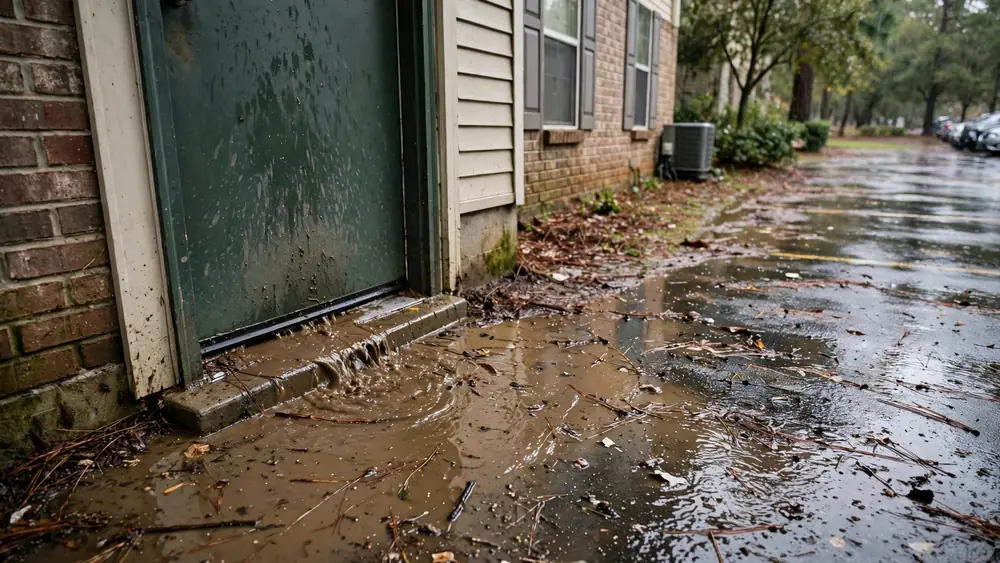
| Muddy water at door during rain | Parking lot runoff, blocked drain | Manager; county dispatch for public drains |
| Dark water from tub or toilet | Shared drain backup | Manager and county dispatch if widespread |
| Clean water through ceiling | Unit above or supply line | Manager and neighbour upstairs |
| Damp wall with no event | Seepage or high humidity | Manager, in writing |
| Water at equipment closet | Water heater or AC drain | Maintenance |
First steps
If a low unit takes on water
- 1
Move to safety
Step out if water reaches outlets or appliances, and never walk through water that may be contaminated.
- 2
Tell management right away
Use the after-hours line, then follow up with a written message and photos.
- 3
Stop using drains if it is a backup
Ask neighbours above you to do the same if you can reach them.
- 4
Lift what you can
Get documents, medicine and electronics up high.
- 5
Report public problems
Broken storm drains, overflowing manholes and major rain flooding go to county dispatch. [2]
- 6
Keep records
Note times, names and what you were told.
Slabs and walls
Drying a ground-floor unit
Ground-floor apartments usually have carpet or vinyl on slab. Carpet pad comes out after anything except a very clean, quick event, and vinyl may have to be lifted if water is trapped below it. Drywall on the lowest course absorbs water from the slab, so flood cuts are common, and walls between units may need to be opened on both sides. Water that came from outside or from a sewer line is treated as contaminated, which means more removal, cleaning and protective measures. [4]
Humidity can remain high long after the event, particularly where windows are small and a building has little ventilation at that level. Run the air conditioning if it is safe, and ask whether a dehumidifier can stay for a while. If mold appears, report it in writing, because the fix depends on the owner dealing with the moisture.
Sumps and drains
Equipment owners should check
Some properties depend on sump pumps, area drains or trench drains at the bottom of ramps and stairwells. A pump that has failed, or a grate clogged with parking-lot debris, can flood a lower level in a single storm. [5] Managers should clear grates ahead of storm season and test pumps, and they should find out who to call for private storm lines on the property. The county handles public systems and takes reports through its dispatch line, but private lines on a property are usually the owner's to maintain.
Flood risk
Check the map, even as a renter
Look up the address on FEMA's Flood Map Service Center. [6] A low unit may flood from local drainage even outside a mapped zone, and a typical renters policy does not include flood damage. The federal program offers contents coverage for renters, with a usual 30-day waiting period, so it has to be arranged before a storm is forecast. [3] If you have repeatedly taken water, keep records and raise it with your landlord in writing. Georgia law places a duty on landlords to keep premises in repair; a lawyer or legal aid service can advise on your situation. [7]
Shops
Low-lying storefronts
Shops at the low end of a strip center can receive water from the whole parking lot. Sandbags or removable door barriers may help on the day, but talk to your landlord about grading and drains as the long-term fix. Keep stock off the floor, have a list of what is stored low and know where your floor drain is. After any water from outside, food and porous goods need particular care, so check with the county health office about what can stay.
Mold and records
After the water goes down
Ground-floor rooms are where mold complaints most often begin, since the walls wick moisture and air moves poorly. Pull furniture a little away from walls, keep closet doors ajar and report any growth or lingering smell in writing, with a date and a photo. Do not paint over it or try to hide it, and if it covers a large area, leave the cleanup to people with experience. [8] If you are told that a room has been dried, it is reasonable to ask whether readings were recorded. Managers should keep a file showing every storm or backup that affected each low unit, as repeated events point to a drainage or plumbing fault that one more round of drying will not cure. Patterns in that file make a far stronger case for repair than individual complaints do.
Questions
Questions about low units on the corridor
Why does sewage come up in my apartment and not upstairs?
Wastewater backs up to the lowest opening on a blocked line, and that is often a ground-floor fixture. Stop using water, keep out of it and tell management at once. If several units or a street manhole are affected, report it to Gwinnett dispatch as well. [2]
Should I stay in a ground-floor unit after a backup?
Usually not until it has been cleaned, particularly with children or anyone vulnerable. Ask management in writing about what will happen next, and check your renters policy for temporary housing coverage. Keep any receipts in case you are able to claim them.
Can I buy flood insurance as a renter?
Yes, contents-only coverage is available through the National Flood Insurance Program in participating communities. A waiting period of 30 days usually applies. Your agent can check whether it makes sense at your address. [3]
Who fixes a blocked drain in the parking lot?
On private property the owner or manager usually does. Public storm drains, street flooding and broken drains get reported to the county dispatch line. If you are not sure which it is, tell both. Avoid stepping near a flooded grate, because a missing cover may be hidden under the water.
Sources and citations
- [1]Wikipedia: Buford Highway
- [2]Gwinnett County Water Resources: Report a problem
- [3]FEMA: National Flood Insurance Program
- [4]U.S. EPA: Flood cleanup and indoor air quality
- [5]Wikipedia: Sump pump
- [6]FEMA: Flood maps
- [7]Justia: O.C.G.A. section 44-7-13, landlord duty to repair
- [8]U.S. EPA: Mold cleanup in your home