Key facts: Basement Water Damage in Berkeley Lake
What differs
Several buried walls, not just one
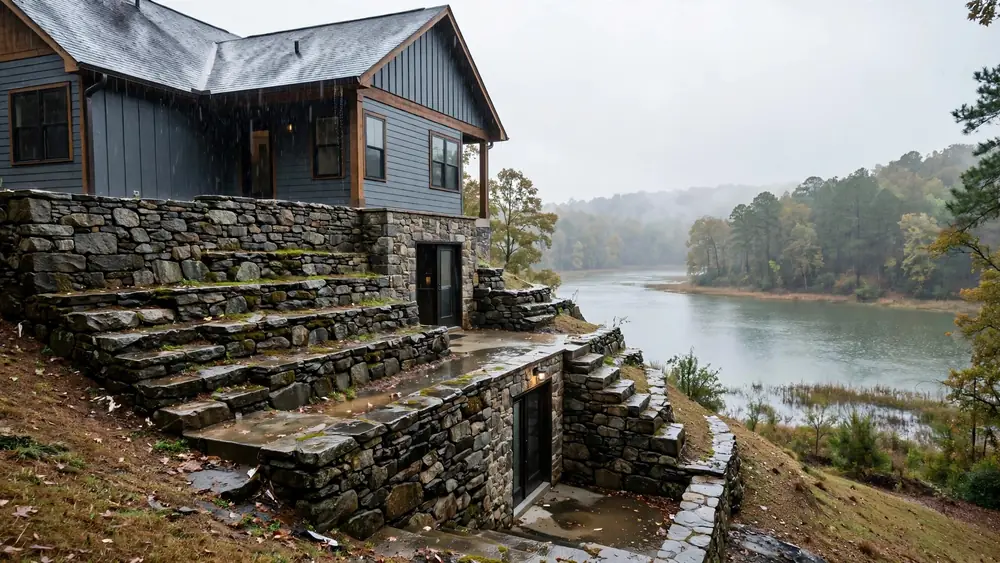
On a steep Berkeley Lake lot, one house might have a buried wall at each level, with crawl sections tucked behind or beneath them. Rain that soaks into the slope above runs down along the rock or denser subsoil and reaches each wall in turn. The soil series around here are classed as well drained by the USDA, but water moving downhill does not stop for a wall. [1] This is why a stain may appear in a mid-level room with no sign of a problem on the floor below.
Interior surveys therefore need to take in every buried wall. Note which rooms get damp after rain, and how long afterward. A delay of a day or two usually suggests water working through the slope, while a quick response points to surface water or a gutter. Simple dated notes and photographs give a contractor much more to go on than memories.
Retaining walls
Walls holding up the hill
Stepped lots rely on retaining walls, and those walls depend on drains and weep holes. If they clog, pressure builds behind the wall, and the water that would have drained away may push toward the house. Look for bulges, leaning sections, fresh cracks or wet patches that never dry. Those are matters for an engineer or an experienced contractor, and restoration crews cannot assess them on their own. Do not let anyone dig at the base of a wall that seems to be moving, and keep people away until it has been assessed. Tell your insurer as well if damage has resulted.
Lot position
How position on the hill changes the risk
| Position | Main issue | First check |
|---|---|---|
| Top of slope | Roof runoff, attic lines | Gutters, downspout discharge |
| Mid-slope | Neighbours' runoff, buried walls | Uphill surface flow |
| Below a road | Street and storm drain water | Catch basins and swales |
| Lakefront | Low-level flooding, sewer connection | FEMA flood map, door sills |
| Near the river boundary | Flood mapping and creeks | Flood map and flood cover |
Getting it dry
Sequence for a wet stepped house
- 1
Identify water type
Lake or outside water is treated as contaminated, and sewage even more so.
- 2
Pump and extract
Discharge away from the foundation, and not toward the lake or a neighbour.
- 3
Open the buried side
Remove wet drywall and insulation so that the wall and framing can be read.
- 4
Cover crawl soil
A continuous barrier in crawl sections limits rising moisture.
- 5
Dehumidify level by level
Close off stairs or hang plastic so that damp air does not simply rise through the house.
- 6
Fix the drainage
Clear surface routes and old drains before finishes return.
Lakefront
Low floors near the water
A lake gives you a view, and it also marks the lowest point nearby. Look up your property on FEMA's map, and do not assume that either a mapped or an unmapped result settles the matter. [4] Lake levels, dam operation and rules for docks and shoreline work belong with those who manage the lake and with the city, not with a restoration contractor. If your lowest floor has taken on water from outside, treat it as contaminated until you have reason to think otherwise, and keep electrical panels and appliances out of use until checked. Flood insurance has its own rules, including a usual 30-day wait and limits in basements. [3]
Sewer connection
Backups on the lowest level
If your lowest fixtures sit downhill of the sewer connection, you may rely on a pump or grinder, which needs power and maintenance. An alarm on such a pump deserves prompt attention, because the next stop for the wastewater is your floor. A power cut during a storm may mean holding off on water use. Homes on a gravity connection can get backups as well, and the county takes those reports through its dispatch line while the private lateral stays the owner's concern. [5] [6] Ask a plumber what your house has if you do not know.
Permits
City Hall comes first
Regrading a slope, building or rebuilding a retaining wall, or adding a drain could all involve city rules, and possibly stream or shoreline protections close to the water. Berkeley Lake asks residents to contact City Hall when they are not sure about a permit. [2] Finished-level rebuilds with electrical or plumbing work usually need one. Ask early, particularly if your drain plan sends water to a different part of the lot, because neighbours downhill will notice any change.
Living with it
Watching a stepped house over time
A hillside home changes with the seasons, and a little regular attention will reveal much. Keep a note of which walls show damp, on what date and after how much rain. Check weep holes and surface drains after autumn leaf fall, and walk the uphill side during a steady rain if it is safe to do so. A small hygrometer on each lower level gives you a reading to compare over the months. Anything new, such as fresh cracks, a wall that seems to lean or a door that has begun to stick, deserves a closer look. Pass your notes on to anyone you hire, and to the next owner when the time comes.
Keep that record somewhere dry, on an upper floor.
Note the rain as well.
Questions
Berkeley Lake lower-level questions
Why is my middle floor damp when the lowest floor is dry?
In a stepped house, a mid-level wall is buried too. Water moving down the slope reaches it directly, and the lower floor may have a separate wall or drain. Note when the dampness appears after rain, and have that specific wall read for moisture and checked outside.
What should I do if my retaining wall is leaning?
Keep people and vehicles away from it, and get an engineer or experienced contractor to look at it promptly. Do not dig near its base. Photograph it and note any changes. If it threatens the house, tell your insurer and consider calling the city.
Do I need flood insurance on a hill?
Only your location and your tolerance for risk can answer this. A home high on the slope might have little river or lake risk, although runoff can still occur and is treated differently by each policy. Check FEMA's map and go through the options with your agent. [4]
Can I pump water from my basement into the lake?
Do not assume so. Contaminated water must not go there, and even clean discharge can erode a slope. Ask the contractor to discharge to a suitable drain or a stable downhill area on your property, and check with the city if you are unsure.